Marketing Organisation
What a Board Wants to See from Marketing: The KPI Framework Before the Next Budget
Christian Drongowski, Fractional & Interim CMO, Berlin · Last updated:
A board wants four things from marketing: what a customer costs, when that cost is earned back, whether the machine is running and what the outlook is for the coming months. Impressions, click-through rates and cost per lead do not belong in that report. They run the machine, but they do not prove it earns. This article describes which metrics belong in a marketing team's board report, why blended CAC is the steering number and how a report has to be built so the next budget round starts with business numbers instead of a channel table.
Why more budget without a working engine changes nothing
More budget on a structure that does not work produces more activity and not one additional customer. That is the experience behind almost every disappointing budget round: marketing got more money, the dashboards turned greener and the number of new customers barely moved.
The reason is rarely the individual campaign. It is that the engine is not in place. A marketing engine consists of a clear positioning, a lead definition that marketing and sales share, a CRM where that definition holds, a handover to sales that works and reporting that runs from first touch to closed deal. If one of those parts is missing, additional budget leaks out exactly there.
How you can tell the engine is missing: marketing reports in leads or, just as readily, in cost per lead, sales reports in closed deals and nobody can say how one number leads to the other. The rise in cost per customer only shows up when annual planning comes around. And the answer to why growth has stalled is "more reach", because reach is the only lever anyone can see.
Only once the engine stands does more budget pay off. Then one more euro becomes a measurable increase in customers. Before that it is an experiment with an open outcome.
Which metrics belong in a board report?
A board report holds the metrics that carry capital decisions: customer acquisition cost (CAC), the ratio of customer value to CAC, the payback period and, for recurring revenue, net revenue retention. Everything else is steering information for marketing itself.
Marketing teams love their numbers. Daily dashboards, red and green fields, movement in every direction. That is part of the craft. But a five percent rise in impressions means nothing at the board table. The people sitting there allocate capital. They want to know what a customer costs, not what a lead costs.
The table below shows the translation. On the left, the numbers marketing works with every day. On the right, the four numbers the board reads.
| What marketing steers daily | What the board reads | What the number answers |
|---|---|---|
| Impressions, click-through rate, conversion rate, cost per lead, ROAS, by channel and campaign | CAC (customer acquisition cost) | What does it cost to win one customer? Blended across all spend for the board, as granular as needed for marketing and sales. |
| Lead quality, deal size, churn signals | LTV to CAC | What is a customer worth over their lifetime, measured against the same CAC? Roughly 3 to 5 is the common orientation for "healthy", the right value depends on the business model. |
| Payment terms, margin, contract length | Payback period | After how many months is the CAC earned back after gross margin? Shorter is better, 9 to 24 months is typical depending on model and deal size. |
| Upsell, expansion, churn in the existing base | NRR (net revenue retention), for recurring revenue (SaaS) | Does the existing base grow on its own? Above 100 percent means yes, even without new customers. |
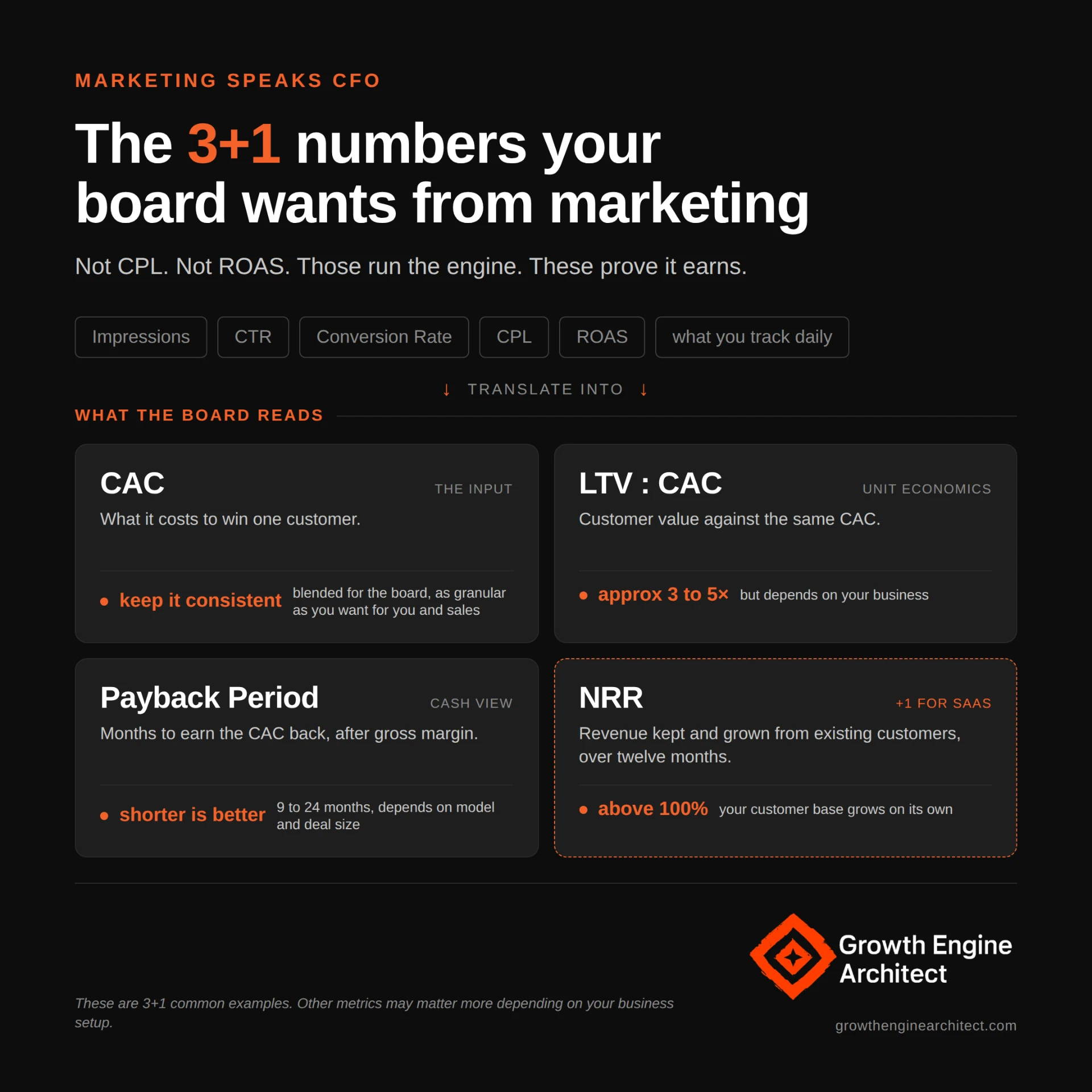
These four are the common examples. Depending on the business model, others join them or take their place. In long sales cycles without recurring revenue, NRR drops out and pipeline development across several quarters takes its place. The logic stays the same: the board gets the numbers that carry a capital decision, marketing keeps the numbers it uses to produce those results.
Why blended CAC is the steering number
Blended CAC is the one number through which all of marketing can be steered, because every improvement in the funnel ends up in it. A better conversion rate lowers CAC, unless the additional leads were bought at twice the price. A better handover to sales lowers CAC. A channel that delivers many cheap leads that never become customers pushes it up, no matter how good the cost per lead looks.
Blended means all costs of customer acquisition in one view, across every channel, region and product. That is the number for the board, because it shows the state of the machine in a single value. For its own steering, marketing of course breaks the same CAC down by region, product and channel. That is where decisions are made about what to cut and what to feed.
What matters is the comparison over time. A CAC without a previous period is a snapshot and does not answer the question the board is actually asking: where is this business heading? Only blended CAC across several months or years shows whether the machine is getting more efficient, standing still or running more expensively. LTV to CAC and payback period hang directly off it. Whoever has CAC under control has the other two under control as well. And one more thing: annual budgeting is built on the CAC the company wants to reach in the financial year.
What does a board report look like that holds up?
A board report holds up when it looks the same every month, shows development instead of snapshots and says plainly where things are stuck. The metrics are the content, the structure decides whether they land.
Three rules that have proven themselves across many board meetings:
The same storyline, every time. Same structure, same order, same definitions. The board should recognise the development, not learn to read a new layout every month. Recognisability is the precondition for numbers being compared at all.
The funnel at high altitude, always with the previous period. Absolute numbers without a comparison period confuse. The board wants to see how pipeline, closed deals and CAC developed against last month and last year, not how many leads came in this month.
An honest three-way split. What went well, what needs improvement, where things are stuck and blocking. The third part is the most important. A board that knows the blockage can help remove it. A board that only sees green fields becomes suspicious at the first dip. No board believes everything is always fine. Reality looks different.
What a board wants to know beyond that is the same in every meeting: is the machine running? If something is disturbing it, what does that do to the forecast? And what is being done to get it running again? A report that answers those three questions every month no longer needs to justify its budget.
What investors check in marketing before a funding round
Before a round, investors check whether marketing is a predictable system or a collection of activities. The questions that come up are almost always the same: how has CAC developed over the last quarters? How long until a customer has earned back their acquisition cost? How much pipeline is created per euro invested, and how stable is that figure? What happens to CAC if the budget doubles?
The last question is the decisive one. Marketing that can only scale reach answers it with a hope. Marketing with a standing engine answers with a number from the past: this is how CAC behaved the last time budget went up and this is the corridor we expect for the next step.
Investment readiness in marketing therefore does not mean having a good-looking deck. It means the four metrics from the table above exist for at least twelve months, marketing and sales use the same definition of customer and pipeline and the forecast is derived from those numbers rather than sitting next to them. Whoever builds that before the round leads the due diligence instead of chasing it.
Why the board number is created at the handover to sales
In long sales cycles, the board number is created neither in marketing nor in sales, but at the handover between the two. A lead that counts as qualified in marketing and sits untouched in sales raises CAC without it showing up in either dashboard.
That is why a solid KPI framework starts with a shared lead definition. Marketing and sales write down what a qualified lead is, the CRM is the place where that definition holds and both sides report against the same number. Then comes the handover: when does a contact move from marketing to sales, who owns it from then on, what happens to contacts that are not ready yet. The middle of the funnel, where contacts mature over weeks and months, needs its own care, otherwise marketing pays for leads that sales never sees.
Only once that chain is measured end to end, from first touch to closed deal, is CAC a real number rather than an estimate. And only then can the board trust it.
A self-check in three questions
Three questions you can answer in ten minutes that show whether your marketing reporting is board-ready:
Can your board name last quarter's blended CAC without asking? If not, marketing is reporting in the wrong language.
Does every number in the report have the previous period next to it? If not, the board is seeing snapshots, not development.
When asked about the pipeline, do marketing and sales name the same number? If not, there is no shared definition and CAC is an estimate.
Three times yes means the engine stands and more budget will land. A no is the point where the work starts, before budget is discussed.
Frequently asked questions
Which metrics should marketing report to the board?
Four metrics carry capital decisions: blended CAC across all spend, the ratio of customer value to CAC, the payback period and, for recurring revenue, net revenue retention. Channel metrics such as impressions, click-through rate or cost per lead stay in marketing, where they are needed.
What is the difference between CAC and cost per lead?
Cost per lead says what it costs to win a contact. CAC says what a customer costs, with all costs included. Between the two lies the entire path through the funnel to the closed deal. A channel can deliver very cheap leads and still push CAC up if those leads rarely become customers.
Why blended CAC instead of CAC per channel?
The board allocates capital to the company, not to channels. Blended CAC shows the state of the whole machine in one number and can be compared across periods. The breakdown by channel, region and product is what marketing needs for its own steering, not the board. And that breakdown can and must change within marketing, for example through seasonal effects.
What do investors check in marketing before a funding round?
The development of CAC over several quarters, the payback period, pipeline per euro invested and above all how CAC behaves at a higher budget. Marketing with a standing engine answers that with numbers from the past.
How often should marketing report to the board?
Monthly in the same structure, with the previous period and the previous year for comparison, plus an annual view. What matters is not the frequency but that the board sees the same layout every month and can recognise development.
What does a Fractional CMO do when building a KPI framework?
Sets the lead definition with sales and management, configures the CRM so that it holds there, builds measurement from first touch to closed deal and translates the results into a board report that looks the same every month. The framework stays with the company when the mandate ends.
I work as a Fractional & Interim CMO for growth companies with long sales cycles. I come in when marketing leadership is missing and leave when it is in place. How an engagement with me is structured is on the page Fractional CMO Germany →.
If you could not answer the self-check with three times yes: Book a strategy call →